Showing posts with label critical illness. Show all posts

Tuesday, 4 August 2015

The catastrophic impact of a debilitating illness

I recommend you spend 6 minutes of your time today to watch this video, made by +7families, a charity-led campaign.


This couple have lived this ordeal since 2012. One bit of luck they had was that 7 Families chose to support them financially by donating the money they would have received had they insured against such a problem.
[7 Families] aim to highlight the need for people to plan financially in case they become too ill to earn an income and the charity Disability Rights UK are working with seven families where the main breadwinner has been forced out of work by an accident or illness and not received any related insurance pay out.
We live in a country where more people insure their pets than themselves. Yet the impact of losing your income can be disastrously higher than paying a vet's bill.

No matter whether you are just starting out in your first job, buying a home, having a family, or if your children have flown the nest, if you haven't yet seriously considered protecting you and your family against the financial meltdown of not being able to work, ask your financial adviser to talk to you about this.


Thursday, 17 April 2014

Self-employed face protection ‘gap’ risk

An increasing number of people have become self-employed in recent years. If you are among them, you may have found the switch has left you without the employment benefits you previously took for granted.


Between 2008 and 2012, the number of people whose main job was self-employed rose by 367,000. Sixty per cent of this increase occurred between 2011 and 2012 – a possible result of the recession. The number of self-employed people in the UK now stands at 4.37 million, representing 14.5% of the working population.

Making the change from being employed to self-employed is clearly a big step – and it’s one more people are taking. But while some may find their income rises, it can be easy to forget about replacing lost employee benefits including sick pay and life insurance.

Lost employee benefits


Many employed people automatically benefit from life insurance, arranged on their behalf by their employer. This would pay a multiple of their annual salary were they to die, which could then be used to pay off a mortgage or provide funds to support their family in the future.

They may have also received a proportion of their salary for a period of time (that exceeded the statutory sick pay levels) if they were unable to work due to illness or injury, and benefitted from access to private medical treatment. Clearly moving from employment to self-employment would mean these benefits cease, potentially leaving a protection ‘gap’.

Plugging the protection ‘gap’


Fortunately, the insurance cover you may have benefited from as an employee is also available to you as a self-employed individual – and it may be more affordable than you think. 

Income protection insurance will pay you a monthly income to cover your living expenses should you be unable to work through illness or injury, and should be considered an essential piece of protection. It can help prevent your family suffering financial hardship, and help you recover more quickly without the burden of financial worry. Many insurance companies also provide support for customers to help them
return to fitness as quickly as possible.

A life and critical illness plan will pay either a tax-free lump sum or a regular income should you suffer a serious illness, or die, and can help secure your family’s financial future.

Private medical insurance may be considered less of a priority than either income protection or life insurance, given the treatment you are entitled to from the NHS.

For those seeking to replicate all the benefits they may have enjoyed when employed, there are a range of policies available at varying price levels.

Are you covered?


If you are self-employed, it is easy to ensure that your employment status doesn’t put your long-term financial security – and that of your family – at risk.

To discuss your protection needs, speak to your financial adviser.

Saturday, 20 July 2013

How Well Protected Is Your Business?


To safeguard your business you have probably secured buildings insurance, machinery or equipment insurance and indemnity or public liability insurance. You may have covered the tangible assets of your business, but have you protected the most important assets: the people that directly contribute to your profits? Are your profits protected should you lose employees unexpectedly? How will your business profits be protected if you or your business partner is taken ill and can’t work?

If you run your own business, you probably have one or more key employees that are integral to its success. These are the people who possess the skills, knowledge, experience or leadership that makes a vital difference to your bottom line.

Does your business have a Sales Manager with an established network of contacts perhaps? Do you have highly skilled or technical staff? What about you, the director or business owner? Have you considered what would happen if they suddenly died, or suffered a critical illness that forced them to be absent from work for a long period of time?  Have you considered the costs and time implications associated with recruiting a locum or temporary contractor to fill the gap? What effect will their absence have on your business’s profits?

If the unexpected happened before you've had a chance to protect against such loss, your business would be at risk of collapse.


Q. What is Key Person Insurance? 

Key Person Insurance is a simple way for businesses making a profit to insure their business against the losses they might suffer as a result of the death, disability or critical illness of a key individual.

Q. My business is very small with fewer than ten staff. Do I need to be concerned with Key Person Insurance? 

Absolutely.  With a small business key people are more likely to be responsible for a larger proportion of the company’s profits. If the unexpected were to happen, then the impact for a small business would be dramatic and could have huge consequences financially.

Q. My business is larger with more Key People. What should I do? 

Large businesses should also consider Key Person Insurance. FTSE100 companies all insure their key people as part of their business continuity plan. Even though the impact of one person no longer coming to work wouldn’t be as financially disastrous for a very large firm, they still consider it vital to protect their profits.

Q. Is there any other cover I should be aware of to protect my business? 

Yes. As part of your business continuity planning you should consider shareholder protection and loan protection. These provide the business with cash to buy the shares of a deceased or seriously ill director, or repay a loan should the bank, for example, recall this on the death of a director. Whether you are a sole trader, partnership or a Limited Company, you must ensure that your business has the correct financial safeguards in place.

_________________________________________________________

With over 25 years of experience in helping people make their financial plans, Ewing Associates build strong trusted relationships with our clients. We offer an expert and friendly financial planning service.
Our experience covers personal and corporate financial advice. We fully understand the individual needs of every client and provide a first class service.
We will help you understand the numerous financial services available, tailor the right solution to your specific needs and help make your money work harder for YOU.
Ewing Associates’ services include mortgage advice, personal and corporate financial planning, investment advice and estate planning.
E-mail andrew@ewingassociates.co.uk or call 01480 357100 for more information


Wednesday, 5 December 2012

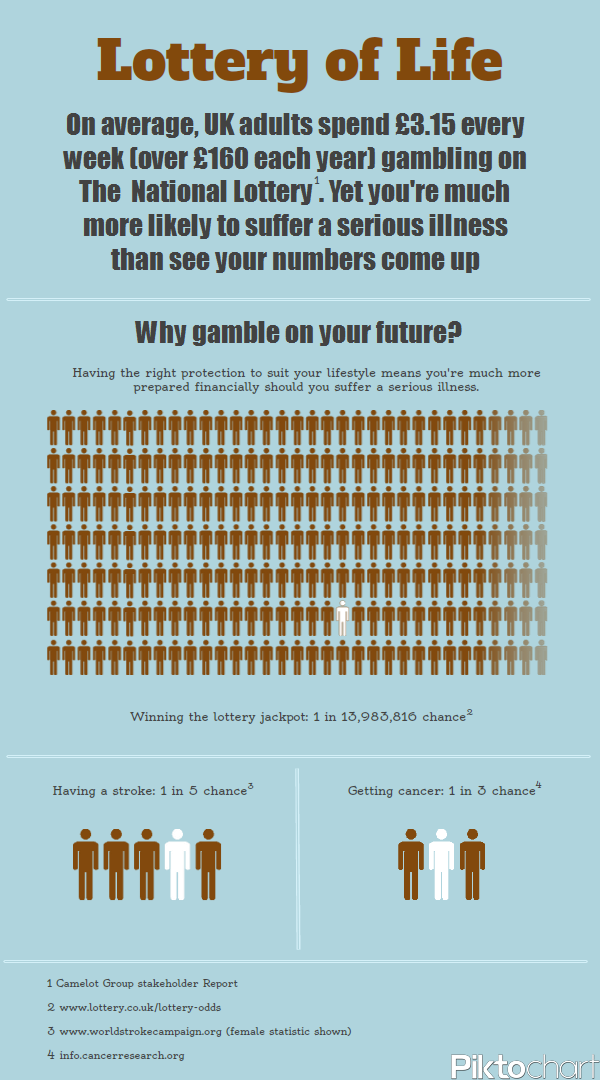
Lottery of Life

Critical Illness Insurance

What it does

Critical illness insurance pays out a tax-free lump sum on the diagnosis of certain life-threatening or debilitating (but not fatal) conditions including heat attack, stroke, cancer, and major organ transplants. This list will vary depending on the insurer, as will the exclusions for making a claim.

Critical illness often comes as an optional addition to a life insurance policy, but can also be purchased on its own. Policies usually only pay out once, so they don't necessarily replace your regular income, but you can use the money towards medical treatment, your mortgage or anything else you choose.


Why you might need it

Many people buy critical illness insurance when they take on a major commitment, like a mortgage, or start a family. However, since we'd all like to have our financial commitments lightened if we were to suffer a serious illness or injury, the cover is relevant for most of us at any time.

Replacing an existing critical illness policy

If you already have critical illness insurance you should think carefully before you cancel your existing policy and take our a new one.

For example, if you've developed any illnesses since you first took out the policy, you may lose some of the benefits when you replace  it. That's because pre-existing medical conditions may not be covered by the new policy.

Recent advances in the treatment of certain conditions, such as cancer, may also have an effect, as a new policy might be more restrictive than an older policy when it comes to paying claims for certain conditions.

A good financial adviser should be able to quickly identify the issues and help you make the right decision about your critical illness insurance.

Wednesday, 5 September 2012

The financial regulator wants a change to the way financial products are sold. A reaction to Martin Wheatley's speech.

In a speech published today, the Managing Director of the FSA, Martin Wheatley says he intends to change the culture of how consumers are viewed and sold to by some financial organisations. This follows the recent PPI and loan mis-selling scandals, as well as other ativities which have tarnished the public's view of the financial services industry, such as Libor abuse and the mis-selling of interest rate products to small businesses. Mr Wheatley goes on to say:
But what is also still clear is that we need financial services more than ever. Most of us need to save more for our retirements, but many are not doing enough. And all of us need a strong, profitable financial services industry that can give us the advice we need to guide us, that can help to protect us from the unforeseen, and that can deliver the products that will help us achieve our life goals.
I completely agree with this; it not only explains why the industry needs to be ethical, but also any business which correctly identifies and plugs such gaps in people's lives will be contributing to their own long-term success by doing so. But what does concern me is how the FSA or the FCA might further restrict the ways in which good quality, relationship-based financial advisers can operate, potentially resulting in fewer people receiving important financial advice.

Although Mr Wheatley's focus appears to be on the non-advised arena that consumers will most likely encounter on the web and along the high street, the ideas he presents are high-level and therefore rather general. At this stage it's difficult to ascertain whether protection products such as life insurance, critical illness, and income protection will ultimately be affected by these plans. If they are, then it's important to get the balance right between protecting consumers from unscrupulous salespeople and not hindering, but rather improving accessibility to and awareness of good financial advice.

Pricing Customers Out


If advisers were no longer allowed to be remunerated by providers of protection products this would inevitably lead to a fee-based system similar to that for investment advice following changes brought about by the Retail Distribution Review (RDR). The problem with this approach for protection, is that few consumers actively seek protection advice. I suspect even fewer would be willing to pay a fee for it, especially if protection and life insurance can still be bought on a non-advised basis direct from providers over the internet, for example.

If we did reach such a situation it would likely lead to more consumers buying cover which may not be best suited to their needs (e.g. paying more for level term when only decreasing mortgage protection is required; creating a potential inheritance tax issue; not correctly assessing what sums insured are needed for family protection; not writing policies in trust and thereby failing to avoid probate delays). Or, worse still, we could see more people not taking out any cover at all and leaving their families unprotected because of a public perception that advice is too costly.

The Best of Both Worlds

To ensure protection customers continue to receive the best outcome, I believe that insurance providers  should continue to pay advisers for finding their clients. This way, advice and recommendations can still be offered with no fee required from the customer. Upfront fees would no doubt alienate a large proportion of the public who might otherwise have benefited from protection.

What I think is key to improving the service which consumers receive, is that non-advised selling of protection products should cease. This would ensure that all protection customers have received advice on what is right for their present circumstances. Every policy written should have evidence of its suitability for each particular client, including less/more expensive alternatives that were available yet not appropriate, features which were included/excluded and why they were/weren't right for the client.

This would result in the best of both worlds for consumers: no fee means a similar proportion as at present would still perceive financial protection as an accessible and affordable avenue to explore; and offering protection on an advised-only basis minimises the opportunity for mis-selling (due to current methods of quality monitoring) as well as providing all the added benefits of the advice process.

Let's hope, for the sake of consumers and their families, the FCA see things from a similar perspective.

Monday, 27 August 2012

Could you cope financially if you were diagnosed with a serious illness?

Some things are more reliable than others - monthly bills, for example. Young or old, single or married, we all have financial obligations to meet each month; be it luxuries, like a satellite TV subscription or mobile phone contract, or the real essentials – like keeping a roof over your family's head. But some things - like our long-term health - can be less reliable. More than 1 in 3 people in the UK will develop some form of cancer during their lifetime, according to Cancer Research UK. If you became critically ill and were unable to work, those monthly expenses would still need to be covered if you wanted to maintain your lifestyle. Ask yourself: could you cope financially?

Better protecting your finances

An important part of financial planning is to ensure your protection arrangements remain appropriate for your needs. Many people take out life insurance which provides valuable cover and and is designed to pay out in the unfortunate event of your death. But by taking out Critical Illness Insurance, you could receive a tax-free lump sum or monthly income should you suffer a serious illness or a major injury. This could help towards paying off your mortgage, meeting monthly household bills, covering additional medical expenses, reducing the financial impact if you were unable to return to work - or anything else you might chose to spend it on.

Insurance premiums set to increase

Now is also a great time to review your protection needs. At the end of this year, new legislation will require insurance companies to ignore an individual’s gender when calculating premiums. This is expected to result in price rises for men and women in most cases – including for critical illness insurance. It’s therefore important you check your current financial protection needs before this change takes effect. The pricing changes may well lead to a rush of applications to insurance companies in the latter part of this year therefore contact your financial adviser now to help prevent you being caught out by this.

Act now to ensure you are financially protected

To ensure you and your family are financially protected, and to beat any price increases, it would be prudent to review your protection needs at the earliest opportunity. I have found that people tend to put off taking out insurance, as we all have seemingly more urgent, and sometimes more interesting things that need doing. And that is completely understandable. So, while the intention is in your mind, why not pick up the phone now, call your financial adviser, and ask for a protection review.