Showing posts with label financial advisor. Show all posts

Tuesday, 4 August 2015

The catastrophic impact of a debilitating illness

I recommend you spend 6 minutes of your time today to watch this video, made by +7families, a charity-led campaign.


This couple have lived this ordeal since 2012. One bit of luck they had was that 7 Families chose to support them financially by donating the money they would have received had they insured against such a problem.
[7 Families] aim to highlight the need for people to plan financially in case they become too ill to earn an income and the charity Disability Rights UK are working with seven families where the main breadwinner has been forced out of work by an accident or illness and not received any related insurance pay out.
We live in a country where more people insure their pets than themselves. Yet the impact of losing your income can be disastrously higher than paying a vet's bill.

No matter whether you are just starting out in your first job, buying a home, having a family, or if your children have flown the nest, if you haven't yet seriously considered protecting you and your family against the financial meltdown of not being able to work, ask your financial adviser to talk to you about this.


Tuesday, 10 June 2014

A funny place to be asked a question about insurance.

Last week I was asked a question atop a 160ft gantry at Magna Science Adventure Centre seconds before doing a bungee jump.

Part of the Jumpmaster's job is to calm the jumpers' nerves as best he can, by keeping them thinking. Whilst my ankle straps were being attached to the bungee rope (no matter how expert they are, you can't help but think you need to double-check they are doing their job properly!), he asked, "So what do you do for a living?"
"I sell life insurance", I replied, peering over the gantry edge at drop beneath. The Jumpmaster and his crew member found this a lot funnier than I did, at the time.

He then asked a question I've been asked several times before, but usually in much less unusual situations than this, "What's the difference between insurance and assurance?"

I explained that the two terms refer to different things but are often used incorrectly. Insurance describes a policy which has a fixed term, and MIGHT pay out. Assurance usually has no fixed term and WILL pay out when a certain event happens.

Think about annual travel INSURANCE. You pay for a year's cover, but you hope you won't have to claim on it. In the same sense, a life INSURANCE policy to protect your home whilst you pay off a mortgage, for example, lasts until the mortgage is paid off. It is designed to pay out IF you die before the end of the policy. However, we all hope to outlive our mortgage!

A life ASSURANCE policy is designed to pay out WHEN you die, not IF. These are often called whole of life plans, as opposed to term insurance policies. They often have a cash value attached to them as well, which a term policy doesn't.

Anyway, the bungee rope was attached properly, and my life INSURANCE policy continues on towards the end of its term.

Saturday, 20 July 2013

How Well Protected Is Your Business?


To safeguard your business you have probably secured buildings insurance, machinery or equipment insurance and indemnity or public liability insurance. You may have covered the tangible assets of your business, but have you protected the most important assets: the people that directly contribute to your profits? Are your profits protected should you lose employees unexpectedly? How will your business profits be protected if you or your business partner is taken ill and can’t work?

If you run your own business, you probably have one or more key employees that are integral to its success. These are the people who possess the skills, knowledge, experience or leadership that makes a vital difference to your bottom line.

Does your business have a Sales Manager with an established network of contacts perhaps? Do you have highly skilled or technical staff? What about you, the director or business owner? Have you considered what would happen if they suddenly died, or suffered a critical illness that forced them to be absent from work for a long period of time?  Have you considered the costs and time implications associated with recruiting a locum or temporary contractor to fill the gap? What effect will their absence have on your business’s profits?

If the unexpected happened before you've had a chance to protect against such loss, your business would be at risk of collapse.


Q. What is Key Person Insurance? 

Key Person Insurance is a simple way for businesses making a profit to insure their business against the losses they might suffer as a result of the death, disability or critical illness of a key individual.

Q. My business is very small with fewer than ten staff. Do I need to be concerned with Key Person Insurance? 

Absolutely.  With a small business key people are more likely to be responsible for a larger proportion of the company’s profits. If the unexpected were to happen, then the impact for a small business would be dramatic and could have huge consequences financially.

Q. My business is larger with more Key People. What should I do? 

Large businesses should also consider Key Person Insurance. FTSE100 companies all insure their key people as part of their business continuity plan. Even though the impact of one person no longer coming to work wouldn’t be as financially disastrous for a very large firm, they still consider it vital to protect their profits.

Q. Is there any other cover I should be aware of to protect my business? 

Yes. As part of your business continuity planning you should consider shareholder protection and loan protection. These provide the business with cash to buy the shares of a deceased or seriously ill director, or repay a loan should the bank, for example, recall this on the death of a director. Whether you are a sole trader, partnership or a Limited Company, you must ensure that your business has the correct financial safeguards in place.

_________________________________________________________

With over 25 years of experience in helping people make their financial plans, Ewing Associates build strong trusted relationships with our clients. We offer an expert and friendly financial planning service.
Our experience covers personal and corporate financial advice. We fully understand the individual needs of every client and provide a first class service.
We will help you understand the numerous financial services available, tailor the right solution to your specific needs and help make your money work harder for YOU.
Ewing Associates’ services include mortgage advice, personal and corporate financial planning, investment advice and estate planning.
E-mail andrew@ewingassociates.co.uk or call 01480 357100 for more information


Wednesday, 27 March 2013

Fed up with low returns from Cash ISAs?

Cash ISA returns fell after the credit crunch, and at time of writing this you'll do well to find many which return over 3% annually.

So is there a way to make your savings work harder without risking your hard-earned capital during these economically unstable times?

Read on to find out.

The basics explained.


Since the introduction of Individual Savings Accounts (ISA) in the UK in 1999, there have been, broadly speaking, two types: Cash ISAs and Stocks & Shares ISAs.

Cash ISAs are similar to a bank account, apart from the tax treatment. Interest is not subject to income tax nor capital gains tax. Your deposit is as safe as if you had deposited it in an ordinary savings account and the returns are known, at least for the current tax year.

Stocks & Shares ISAs are an investment rather than a deposit. Again, your returns have a different tax treatment than outside of an ISA, but as with other investments, your capital is at risk. So you could end up with less than you invested. However, and this is the main attraction of investments, you could end up with far more than a Cash ISA would have returned. Therefore, they are really only suitable for those who understand and are happy with these risks.

Structured deposits


So, if you aren't happy to risk your capital by investing in a Stocks & Shares ISA and you aren't happy with with the relatively low (compared to years leading up to 2009) interest rate of Cash ISAs, where is the best place to deposit your savings?

What if you were offered the security of a bank deposit account whilst also having limited exposure to underlyings such as the FTSE100 and therefore potentially higher returns than a standard deposit account or Cash ISA? This is essentially a how a Structured Deposit works.

So, you could achieve returns of 6% per annum or more, and those returns are tax free. Sound too good to be true in this day and age? There are some restrictions of course, and an element of low risk.

The risk is that you may receive back only your original deposit at the end of term. Terms usually last 3, 5 or 6 years (although some schemes have paid out, or 'kicked-out' after just 1 year), so you need to be prepared to not make any withdrawals for a number of years. So, for example, if I transferred £10,000 today into a 5-year term structured deposit, I might receive only £10,000 back in 2018 - that is the worst case scenario (assuming our banks don't go the way Cyprus's have recently). If I left that sum in my bank's Cash ISA, it would have grown to £10,050 in 2018 based on the bank's current published rates. So I'm effectively risking £50 to try and get a better return.

So what are those better returns?


Each structured product provider offers different ways of indirectly exposing your money to the markets. These offers usually only have a window of a matter of weeks before they are replaced with different terms. For example, one may be designed to return 100% of any increase in the FTSE100 over a 5 year term e.g. if the FTSE has risen by 40% over 5 years, your balance will have grown by 40%. If the FTSE has fallen by 30%, you will have lost 30%..... except you won't of course! Because you are guaranteed to receive at least your original deposit back. Even though the FTSE may be 30% below its level  when you deposited your money, you don't lose any of your deposit.

To summarise, a structured deposit is deposit based and offers a defined return linked to one or more underlyings, such as the FTSE 100. Structured Deposits are designed to return at least the initial deposit by the end of the product life with any additional return linked to the movement of the underlying. Structured deposits can be held within a variety of tax wrappers such as a Cash ISA.

Where can I find out more about structured deposits?


If you are fed up with low savings and Cash ISA rates, or are just interested in finding out more about these products, have a word with your financial adviser, who should be able to help you find out if structured deposits might be the right place for some of your savings.

Wednesday, 5 December 2012

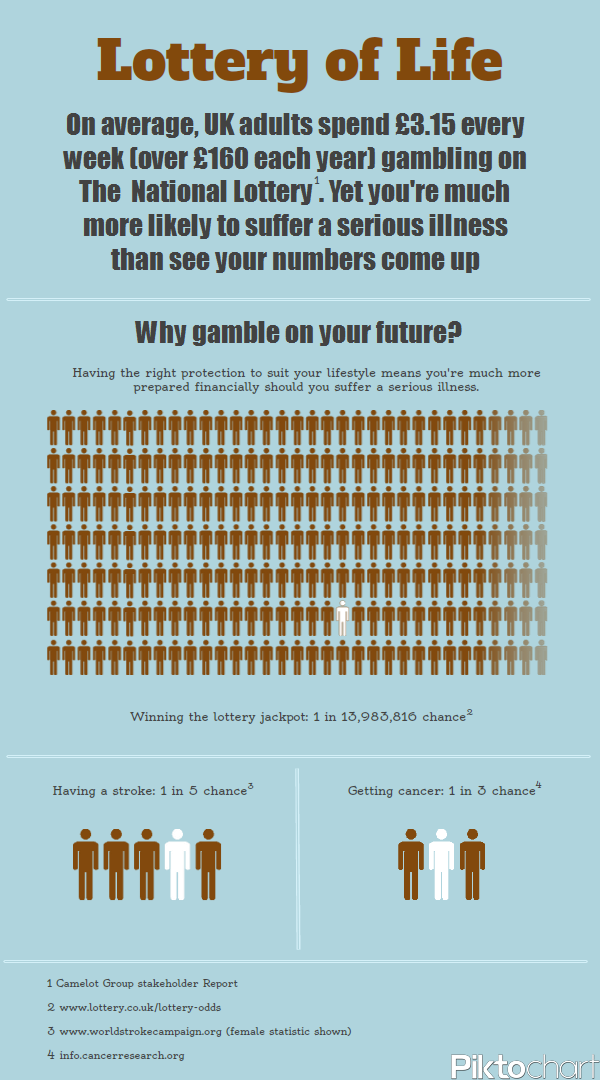
Lottery of Life

Critical Illness Insurance

What it does

Critical illness insurance pays out a tax-free lump sum on the diagnosis of certain life-threatening or debilitating (but not fatal) conditions including heat attack, stroke, cancer, and major organ transplants. This list will vary depending on the insurer, as will the exclusions for making a claim.

Critical illness often comes as an optional addition to a life insurance policy, but can also be purchased on its own. Policies usually only pay out once, so they don't necessarily replace your regular income, but you can use the money towards medical treatment, your mortgage or anything else you choose.


Why you might need it

Many people buy critical illness insurance when they take on a major commitment, like a mortgage, or start a family. However, since we'd all like to have our financial commitments lightened if we were to suffer a serious illness or injury, the cover is relevant for most of us at any time.

Replacing an existing critical illness policy

If you already have critical illness insurance you should think carefully before you cancel your existing policy and take our a new one.

For example, if you've developed any illnesses since you first took out the policy, you may lose some of the benefits when you replace  it. That's because pre-existing medical conditions may not be covered by the new policy.

Recent advances in the treatment of certain conditions, such as cancer, may also have an effect, as a new policy might be more restrictive than an older policy when it comes to paying claims for certain conditions.

A good financial adviser should be able to quickly identify the issues and help you make the right decision about your critical illness insurance.

Tuesday, 2 October 2012

Press Release: Ewing Associates is a Business Focus exhibitor

Press Release: Ewing Associates is a Business Focus exhibitor

Ewing Associates is a Business Focus exhibitor
Ewing Associates has secured a stand at Business Focus, the region's premier business-to-business exhibition taking place at Peterborough Arena on Wednesday 17th October 2012.
Last year's sell-out Business Focus welcomed more than 700 visitors and exhibitors embraced the opportunity to promote their latest products and services to a targeted, receptive audience.
This year's event promises to be even bigger, and will showcase the region's success as the Business Environment Capital of the UK. Exciting new attractions include:
  • The Eco House - a futuristic showhome inside the main exhibition hall
  • The Secret Millionaire - retail consultancy CEO Mike Greene giving inspirational insight into a top-performing business
  • Business Central - the latest innovations from selected exhibitors
  • Foods of the World - the chance to refuel on sizzling cuisine from top regional caterers and suppliers
John Bridge OBE, Chief Executive of Cambridgeshire Chambers of Commerce, said: "Business Focus 2012 enables forward-thinking companies to communicate across Peterborough and the region and engage with new contacts. Those shrewd enough to book their places now, before the exhibition stands sell out, will be the ones that benefit most from this leading business-to-business event."
During the day, influential professional groups and organisations will be among the visitors, meeting stand-holders and talk about the business developments shaping this region. Visitors can attend the exhibition free of charge.
Sponsors of Business Focus 2012 are The Peterborough Telegraph, Peterborough Regional College, Larkfleet Group, Peterborough Arena and Peterborough City Council. The event is organised by Cambridgeshire Chambers of Commerce and The Business Club.
Business Focus takes place at Peterborough Arena, East of England Showground, Peterborough, PE2 6XE, on Wednesday 17 October, 9.00am-5.00pm. Entry for visitors is free on the day.
For further information, visit www.businessfocus.uk.net or call 01733 513002. Business Focus can also be found at www.facebook.com/BizFocus2012 and on Twitter #BizFocus2012

Tuesday, 11 September 2012

As a company director, is your life insurance as tax efficient as it could be?

Relevant life policies are a type of life insurance for employers to provide employees with death benefits.

They can be very useful when there aren’t enough employees to justify a group scheme or, where an individual requires a greater level of benefit than the group scheme provides. As directors working day to day in a business are likely to qualify as employees, this can be a more tax efficient way for a company director to provide life assurance benefits for his/her dependants rather than paying for it personally or it being treated as a benefit in kind.


An example of relevant life insurance and its tax efficiency:

Mrs Anne Other is a shareholding director of A.Other Ltd, an engineering business, and currently has life insurance in place. She wishes to review her insurance as she and her partner are expecting their third child and they would like more cover.

Comparing the two plans that her financial adviser recommends, Anne doesn't hesitate to choose the Relevant Life plan. Below you can see the sums that made her decision easy.

The Relevant Life Plan is particularly beneficial for Anne because she’s the director and shareholder of her own business, so all the savings go to her. If she were to pay for her life cover personally it would cost her £1,569.65 every year. By buying her cover through the company using a Relevant Life Plan, it only costs £800 each year. That’s £769.65 less, which is a saving of almost 50%.

(This is a fictitious example, and also assumes that the Relevant Life plan qualifies as an allowable business expense, which it usually is)


What makes this plan so good for company directors?


  • You can effectively make a big saving on life cover compared with paying for it personally.
  • Premiums are normally classed as a business expense and so are likely to be an allowable deduction for Corporation Tax purposes.
  • Premiums and benefits do not count towards your annual or lifetime allowance – particularly important if you have a large pension fund or wish to maximise your contributions into your pension.
  • Keeping the plan in trust offers the potential to plan for Inheritance Tax if your estate is or is likely to be worth more than the current Inheritance Tax threshold.
  • Offers a cost-effective way to provide Death In Service benefits to your employees.

Any limitations or drawbacks?


Relevant Life Plans are not available for sole traders, equity partners of a partnership or equity members of a Limited Liability Partnership.

It’s a Single Life Policy, which means each plan covers one person – you, for example.

There’s no option to include joint cover, such as for you and your partner, in the same policy.

How do I take advantage of a Relevant Life plan?

Speak to your financial adviser who should be able to discuss the features in more detail.


Wednesday, 5 September 2012

The financial regulator wants a change to the way financial products are sold. A reaction to Martin Wheatley's speech.

In a speech published today, the Managing Director of the FSA, Martin Wheatley says he intends to change the culture of how consumers are viewed and sold to by some financial organisations. This follows the recent PPI and loan mis-selling scandals, as well as other ativities which have tarnished the public's view of the financial services industry, such as Libor abuse and the mis-selling of interest rate products to small businesses. Mr Wheatley goes on to say:
But what is also still clear is that we need financial services more than ever. Most of us need to save more for our retirements, but many are not doing enough. And all of us need a strong, profitable financial services industry that can give us the advice we need to guide us, that can help to protect us from the unforeseen, and that can deliver the products that will help us achieve our life goals.
I completely agree with this; it not only explains why the industry needs to be ethical, but also any business which correctly identifies and plugs such gaps in people's lives will be contributing to their own long-term success by doing so. But what does concern me is how the FSA or the FCA might further restrict the ways in which good quality, relationship-based financial advisers can operate, potentially resulting in fewer people receiving important financial advice.

Although Mr Wheatley's focus appears to be on the non-advised arena that consumers will most likely encounter on the web and along the high street, the ideas he presents are high-level and therefore rather general. At this stage it's difficult to ascertain whether protection products such as life insurance, critical illness, and income protection will ultimately be affected by these plans. If they are, then it's important to get the balance right between protecting consumers from unscrupulous salespeople and not hindering, but rather improving accessibility to and awareness of good financial advice.

Pricing Customers Out


If advisers were no longer allowed to be remunerated by providers of protection products this would inevitably lead to a fee-based system similar to that for investment advice following changes brought about by the Retail Distribution Review (RDR). The problem with this approach for protection, is that few consumers actively seek protection advice. I suspect even fewer would be willing to pay a fee for it, especially if protection and life insurance can still be bought on a non-advised basis direct from providers over the internet, for example.

If we did reach such a situation it would likely lead to more consumers buying cover which may not be best suited to their needs (e.g. paying more for level term when only decreasing mortgage protection is required; creating a potential inheritance tax issue; not correctly assessing what sums insured are needed for family protection; not writing policies in trust and thereby failing to avoid probate delays). Or, worse still, we could see more people not taking out any cover at all and leaving their families unprotected because of a public perception that advice is too costly.

The Best of Both Worlds

To ensure protection customers continue to receive the best outcome, I believe that insurance providers  should continue to pay advisers for finding their clients. This way, advice and recommendations can still be offered with no fee required from the customer. Upfront fees would no doubt alienate a large proportion of the public who might otherwise have benefited from protection.

What I think is key to improving the service which consumers receive, is that non-advised selling of protection products should cease. This would ensure that all protection customers have received advice on what is right for their present circumstances. Every policy written should have evidence of its suitability for each particular client, including less/more expensive alternatives that were available yet not appropriate, features which were included/excluded and why they were/weren't right for the client.

This would result in the best of both worlds for consumers: no fee means a similar proportion as at present would still perceive financial protection as an accessible and affordable avenue to explore; and offering protection on an advised-only basis minimises the opportunity for mis-selling (due to current methods of quality monitoring) as well as providing all the added benefits of the advice process.

Let's hope, for the sake of consumers and their families, the FCA see things from a similar perspective.

Saturday, 25 August 2012

Losing sight of everyday threats could put your business at risk


If you are a business owner or a director, you are no doubt working harder than ever to steer the company through this difficult trading period. As result, your thoughts may be more focussed on the short-term needs of the company more than usual.

But it’s more important now that you don’t lose sight of the ongoing threats to your business – threats that could have an impact as severe as any market downturn.


Protecting your most important assets


If a director, co-owner or key individual within your business were to die, or become critically ill, it could have a serious impact on your company’s ability to trade. For instance:

  • How would the loss of their expertise and experience impact the business?
  • If they are a shareholder, what would happen to their shares? Could the business afford to buy them back?
  • How would your debtors and creditors react? Would loans be called in?

You probably already protect your company’s material assets, like premises, vehicles and equipment. Surely it makes sense to also protect the company’s most important assets – its people.

How you can obtain help


Some financial advisers often work with businesses offering advice on how best to protect them from the financial impact of unforeseen events.

There is a range of products that can give you peace of mind when it comes to the long-term stability of your business.

If it has been several years since, or if you have never conducted a review of your business's protection requirements, it would be a good idea to find a financial adviser who specialises in this area for an appointment. Don't leave your business unprotected until it is too late.