Showing posts with label protection. Show all posts

Tuesday, 4 August 2015

The catastrophic impact of a debilitating illness

I recommend you spend 6 minutes of your time today to watch this video, made by +7families, a charity-led campaign.


This couple have lived this ordeal since 2012. One bit of luck they had was that 7 Families chose to support them financially by donating the money they would have received had they insured against such a problem.
[7 Families] aim to highlight the need for people to plan financially in case they become too ill to earn an income and the charity Disability Rights UK are working with seven families where the main breadwinner has been forced out of work by an accident or illness and not received any related insurance pay out.
We live in a country where more people insure their pets than themselves. Yet the impact of losing your income can be disastrously higher than paying a vet's bill.

No matter whether you are just starting out in your first job, buying a home, having a family, or if your children have flown the nest, if you haven't yet seriously considered protecting you and your family against the financial meltdown of not being able to work, ask your financial adviser to talk to you about this.


Tuesday, 10 June 2014

A funny place to be asked a question about insurance.

Last week I was asked a question atop a 160ft gantry at Magna Science Adventure Centre seconds before doing a bungee jump.

Part of the Jumpmaster's job is to calm the jumpers' nerves as best he can, by keeping them thinking. Whilst my ankle straps were being attached to the bungee rope (no matter how expert they are, you can't help but think you need to double-check they are doing their job properly!), he asked, "So what do you do for a living?"
"I sell life insurance", I replied, peering over the gantry edge at drop beneath. The Jumpmaster and his crew member found this a lot funnier than I did, at the time.

He then asked a question I've been asked several times before, but usually in much less unusual situations than this, "What's the difference between insurance and assurance?"

I explained that the two terms refer to different things but are often used incorrectly. Insurance describes a policy which has a fixed term, and MIGHT pay out. Assurance usually has no fixed term and WILL pay out when a certain event happens.

Think about annual travel INSURANCE. You pay for a year's cover, but you hope you won't have to claim on it. In the same sense, a life INSURANCE policy to protect your home whilst you pay off a mortgage, for example, lasts until the mortgage is paid off. It is designed to pay out IF you die before the end of the policy. However, we all hope to outlive our mortgage!

A life ASSURANCE policy is designed to pay out WHEN you die, not IF. These are often called whole of life plans, as opposed to term insurance policies. They often have a cash value attached to them as well, which a term policy doesn't.

Anyway, the bungee rope was attached properly, and my life INSURANCE policy continues on towards the end of its term.

Thursday, 17 April 2014

Self-employed face protection ‘gap’ risk

An increasing number of people have become self-employed in recent years. If you are among them, you may have found the switch has left you without the employment benefits you previously took for granted.


Between 2008 and 2012, the number of people whose main job was self-employed rose by 367,000. Sixty per cent of this increase occurred between 2011 and 2012 – a possible result of the recession. The number of self-employed people in the UK now stands at 4.37 million, representing 14.5% of the working population.

Making the change from being employed to self-employed is clearly a big step – and it’s one more people are taking. But while some may find their income rises, it can be easy to forget about replacing lost employee benefits including sick pay and life insurance.

Lost employee benefits


Many employed people automatically benefit from life insurance, arranged on their behalf by their employer. This would pay a multiple of their annual salary were they to die, which could then be used to pay off a mortgage or provide funds to support their family in the future.

They may have also received a proportion of their salary for a period of time (that exceeded the statutory sick pay levels) if they were unable to work due to illness or injury, and benefitted from access to private medical treatment. Clearly moving from employment to self-employment would mean these benefits cease, potentially leaving a protection ‘gap’.

Plugging the protection ‘gap’


Fortunately, the insurance cover you may have benefited from as an employee is also available to you as a self-employed individual – and it may be more affordable than you think. 

Income protection insurance will pay you a monthly income to cover your living expenses should you be unable to work through illness or injury, and should be considered an essential piece of protection. It can help prevent your family suffering financial hardship, and help you recover more quickly without the burden of financial worry. Many insurance companies also provide support for customers to help them
return to fitness as quickly as possible.

A life and critical illness plan will pay either a tax-free lump sum or a regular income should you suffer a serious illness, or die, and can help secure your family’s financial future.

Private medical insurance may be considered less of a priority than either income protection or life insurance, given the treatment you are entitled to from the NHS.

For those seeking to replicate all the benefits they may have enjoyed when employed, there are a range of policies available at varying price levels.

Are you covered?


If you are self-employed, it is easy to ensure that your employment status doesn’t put your long-term financial security – and that of your family – at risk.

To discuss your protection needs, speak to your financial adviser.

Saturday, 20 July 2013

How Well Protected Is Your Business?


To safeguard your business you have probably secured buildings insurance, machinery or equipment insurance and indemnity or public liability insurance. You may have covered the tangible assets of your business, but have you protected the most important assets: the people that directly contribute to your profits? Are your profits protected should you lose employees unexpectedly? How will your business profits be protected if you or your business partner is taken ill and can’t work?

If you run your own business, you probably have one or more key employees that are integral to its success. These are the people who possess the skills, knowledge, experience or leadership that makes a vital difference to your bottom line.

Does your business have a Sales Manager with an established network of contacts perhaps? Do you have highly skilled or technical staff? What about you, the director or business owner? Have you considered what would happen if they suddenly died, or suffered a critical illness that forced them to be absent from work for a long period of time?  Have you considered the costs and time implications associated with recruiting a locum or temporary contractor to fill the gap? What effect will their absence have on your business’s profits?

If the unexpected happened before you've had a chance to protect against such loss, your business would be at risk of collapse.


Q. What is Key Person Insurance? 

Key Person Insurance is a simple way for businesses making a profit to insure their business against the losses they might suffer as a result of the death, disability or critical illness of a key individual.

Q. My business is very small with fewer than ten staff. Do I need to be concerned with Key Person Insurance? 

Absolutely.  With a small business key people are more likely to be responsible for a larger proportion of the company’s profits. If the unexpected were to happen, then the impact for a small business would be dramatic and could have huge consequences financially.

Q. My business is larger with more Key People. What should I do? 

Large businesses should also consider Key Person Insurance. FTSE100 companies all insure their key people as part of their business continuity plan. Even though the impact of one person no longer coming to work wouldn’t be as financially disastrous for a very large firm, they still consider it vital to protect their profits.

Q. Is there any other cover I should be aware of to protect my business? 

Yes. As part of your business continuity planning you should consider shareholder protection and loan protection. These provide the business with cash to buy the shares of a deceased or seriously ill director, or repay a loan should the bank, for example, recall this on the death of a director. Whether you are a sole trader, partnership or a Limited Company, you must ensure that your business has the correct financial safeguards in place.

_________________________________________________________

With over 25 years of experience in helping people make their financial plans, Ewing Associates build strong trusted relationships with our clients. We offer an expert and friendly financial planning service.
Our experience covers personal and corporate financial advice. We fully understand the individual needs of every client and provide a first class service.
We will help you understand the numerous financial services available, tailor the right solution to your specific needs and help make your money work harder for YOU.
Ewing Associates’ services include mortgage advice, personal and corporate financial planning, investment advice and estate planning.
E-mail andrew@ewingassociates.co.uk or call 01480 357100 for more information


Wednesday, 5 December 2012

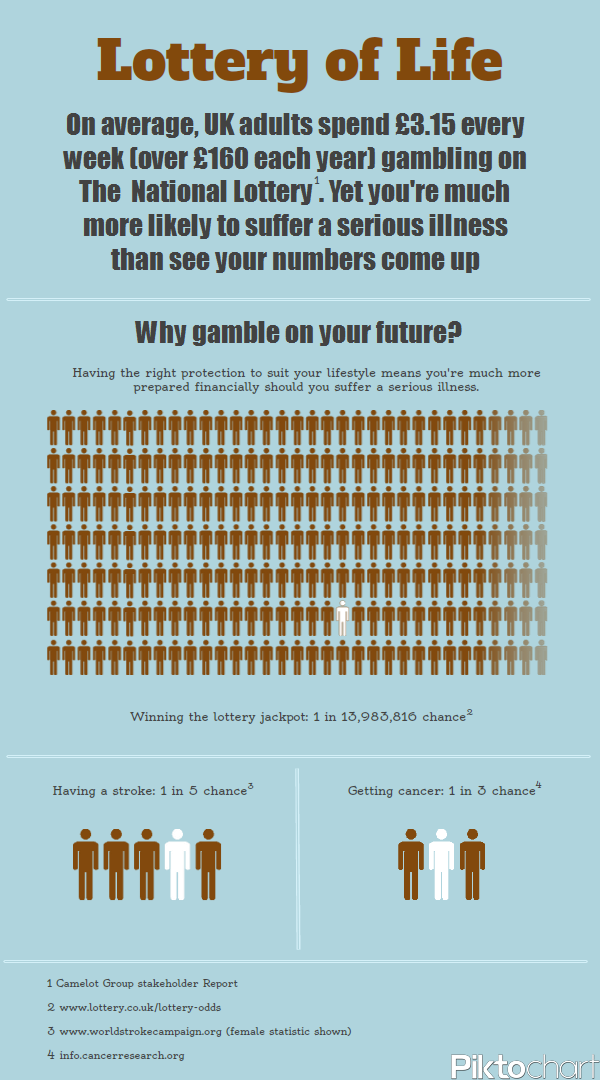
Lottery of Life

Critical Illness Insurance

What it does

Critical illness insurance pays out a tax-free lump sum on the diagnosis of certain life-threatening or debilitating (but not fatal) conditions including heat attack, stroke, cancer, and major organ transplants. This list will vary depending on the insurer, as will the exclusions for making a claim.

Critical illness often comes as an optional addition to a life insurance policy, but can also be purchased on its own. Policies usually only pay out once, so they don't necessarily replace your regular income, but you can use the money towards medical treatment, your mortgage or anything else you choose.


Why you might need it

Many people buy critical illness insurance when they take on a major commitment, like a mortgage, or start a family. However, since we'd all like to have our financial commitments lightened if we were to suffer a serious illness or injury, the cover is relevant for most of us at any time.

Replacing an existing critical illness policy

If you already have critical illness insurance you should think carefully before you cancel your existing policy and take our a new one.

For example, if you've developed any illnesses since you first took out the policy, you may lose some of the benefits when you replace  it. That's because pre-existing medical conditions may not be covered by the new policy.

Recent advances in the treatment of certain conditions, such as cancer, may also have an effect, as a new policy might be more restrictive than an older policy when it comes to paying claims for certain conditions.

A good financial adviser should be able to quickly identify the issues and help you make the right decision about your critical illness insurance.

Tuesday, 11 September 2012

As a company director, is your life insurance as tax efficient as it could be?

Relevant life policies are a type of life insurance for employers to provide employees with death benefits.

They can be very useful when there aren’t enough employees to justify a group scheme or, where an individual requires a greater level of benefit than the group scheme provides. As directors working day to day in a business are likely to qualify as employees, this can be a more tax efficient way for a company director to provide life assurance benefits for his/her dependants rather than paying for it personally or it being treated as a benefit in kind.


An example of relevant life insurance and its tax efficiency:

Mrs Anne Other is a shareholding director of A.Other Ltd, an engineering business, and currently has life insurance in place. She wishes to review her insurance as she and her partner are expecting their third child and they would like more cover.

Comparing the two plans that her financial adviser recommends, Anne doesn't hesitate to choose the Relevant Life plan. Below you can see the sums that made her decision easy.

The Relevant Life Plan is particularly beneficial for Anne because she’s the director and shareholder of her own business, so all the savings go to her. If she were to pay for her life cover personally it would cost her £1,569.65 every year. By buying her cover through the company using a Relevant Life Plan, it only costs £800 each year. That’s £769.65 less, which is a saving of almost 50%.

(This is a fictitious example, and also assumes that the Relevant Life plan qualifies as an allowable business expense, which it usually is)


What makes this plan so good for company directors?


  • You can effectively make a big saving on life cover compared with paying for it personally.
  • Premiums are normally classed as a business expense and so are likely to be an allowable deduction for Corporation Tax purposes.
  • Premiums and benefits do not count towards your annual or lifetime allowance – particularly important if you have a large pension fund or wish to maximise your contributions into your pension.
  • Keeping the plan in trust offers the potential to plan for Inheritance Tax if your estate is or is likely to be worth more than the current Inheritance Tax threshold.
  • Offers a cost-effective way to provide Death In Service benefits to your employees.

Any limitations or drawbacks?


Relevant Life Plans are not available for sole traders, equity partners of a partnership or equity members of a Limited Liability Partnership.

It’s a Single Life Policy, which means each plan covers one person – you, for example.

There’s no option to include joint cover, such as for you and your partner, in the same policy.

How do I take advantage of a Relevant Life plan?

Speak to your financial adviser who should be able to discuss the features in more detail.


Wednesday, 29 August 2012

Trusts. What are they, and why use them for insurance?

It's often said that less than 10% of life insurance policies are written in trust. Although not all policies are suitable for writing in trust, this still leaves a large number of policyholders who haven't taken advantage of this simple option. In this post, I'll explain what a trust is, the benefit of putting one in place, and question why more policies aren't in trust.

What exactly is a trust?

A trust is a relationship recognised by law whereby something is held by one party for the benefit of another. In respect of life insurance, there are normally three parties involved: the settlor (the policyholder); the trustee/s (the person/s to whom the insurance company will pay a claim); and the beneficiary/ies (the ultimate recipient of the money as intended by the policyholder). This may sound complex, in fact they are anything but: they simply allow someone to pass property on to another person at some point in the future.

Why write life insurance in trust?

There are several reasons to write life insurance in trust.
  1. Avoid probate delays. Probate is the legal process which must be completed before your estate can be distributed. This can take anything from a couple of months up to a year, and beyond in some cases. Probate delays can present a problem if an insurer has paid money into your estate and your family requires it sooner rather than later.
  2. Reduce an inheritance tax (IHT) bill. Benefit payed from a life insurance policy written in trust can be paid outside of your estate for IHT purposes.
  3. A trust enables you to choose your beneficiaries, thereby remaining in control of your assets.
  4. Being a simple process (often no more than a one page form), it is normally free of charge set up a trust.

So, why don't more people have one?

Most people I speak to who haven't written their life policy in trust simply weren't aware of trusts and their benefits. With people buying policies over the internet or from direct insurers on a non-advised basis, it may be some time before people are fully aware of their benefits.

Check your existing policies.

If you have a life insurance policy, and are not sure whether it is written in trust or not, it is worth checking. You can do this by asking your insurer or speak to a financial adviser.

Monday, 27 August 2012

Could you cope financially if you were diagnosed with a serious illness?

Some things are more reliable than others - monthly bills, for example. Young or old, single or married, we all have financial obligations to meet each month; be it luxuries, like a satellite TV subscription or mobile phone contract, or the real essentials – like keeping a roof over your family's head. But some things - like our long-term health - can be less reliable. More than 1 in 3 people in the UK will develop some form of cancer during their lifetime, according to Cancer Research UK. If you became critically ill and were unable to work, those monthly expenses would still need to be covered if you wanted to maintain your lifestyle. Ask yourself: could you cope financially?

Better protecting your finances

An important part of financial planning is to ensure your protection arrangements remain appropriate for your needs. Many people take out life insurance which provides valuable cover and and is designed to pay out in the unfortunate event of your death. But by taking out Critical Illness Insurance, you could receive a tax-free lump sum or monthly income should you suffer a serious illness or a major injury. This could help towards paying off your mortgage, meeting monthly household bills, covering additional medical expenses, reducing the financial impact if you were unable to return to work - or anything else you might chose to spend it on.

Insurance premiums set to increase

Now is also a great time to review your protection needs. At the end of this year, new legislation will require insurance companies to ignore an individual’s gender when calculating premiums. This is expected to result in price rises for men and women in most cases – including for critical illness insurance. It’s therefore important you check your current financial protection needs before this change takes effect. The pricing changes may well lead to a rush of applications to insurance companies in the latter part of this year therefore contact your financial adviser now to help prevent you being caught out by this.

Act now to ensure you are financially protected

To ensure you and your family are financially protected, and to beat any price increases, it would be prudent to review your protection needs at the earliest opportunity. I have found that people tend to put off taking out insurance, as we all have seemingly more urgent, and sometimes more interesting things that need doing. And that is completely understandable. So, while the intention is in your mind, why not pick up the phone now, call your financial adviser, and ask for a protection review.

Saturday, 25 August 2012

Losing sight of everyday threats could put your business at risk


If you are a business owner or a director, you are no doubt working harder than ever to steer the company through this difficult trading period. As result, your thoughts may be more focussed on the short-term needs of the company more than usual.

But it’s more important now that you don’t lose sight of the ongoing threats to your business – threats that could have an impact as severe as any market downturn.


Protecting your most important assets


If a director, co-owner or key individual within your business were to die, or become critically ill, it could have a serious impact on your company’s ability to trade. For instance:

  • How would the loss of their expertise and experience impact the business?
  • If they are a shareholder, what would happen to their shares? Could the business afford to buy them back?
  • How would your debtors and creditors react? Would loans be called in?

You probably already protect your company’s material assets, like premises, vehicles and equipment. Surely it makes sense to also protect the company’s most important assets – its people.

How you can obtain help


Some financial advisers often work with businesses offering advice on how best to protect them from the financial impact of unforeseen events.

There is a range of products that can give you peace of mind when it comes to the long-term stability of your business.

If it has been several years since, or if you have never conducted a review of your business's protection requirements, it would be a good idea to find a financial adviser who specialises in this area for an appointment. Don't leave your business unprotected until it is too late.

Friday, 24 August 2012

Life Insurance Premiums Expected to Rise

From 21 December 2012, changes to the EU Gender Directive will mean insurers will no longer be able to use gender as an underwriting factor when setting premium rates. This change will affect all types of personal insurance with life, motor and annuities being among the most significant.

It's sensible to ask your financial adviser for a review of your protection needs before the end of September, as in most cases, life insurance for both men and women will increase (significantly for some) from December. Those who take out a policy before the Gender Directive, will lock in their premiums at this year's prices. Waiting until next year could cost women 22% more for term life insurance, as a compounding factor is also a change to the "I minus E" rule.

From 1 January 2013, life companies will no longer be able to offset the costs of selling life insurance against investment income. This is known as the Income minus Expenses or “I minus E” rule, which many life companies use to subsidise their protection premium rates. As a result, premiums could increase by approximately 10% to compensate.

The perfect storm of gender neutral pricing and I-E will result in life rates rising for the majority, with insurers likely to wrap up rate changes to cater for both gender and I-E together.

Top Tips

  1. Speak to a specialist adviser now. You need to allow enough time for underwriting, as you will need to be accepted on cover before the 21 December. In some cases underwriting can take several months, so make sure you speak to a good financial adviser, or a specialist protection adviser as soon as possible.
  2. Tell others you know who have gone through a life change recently (e.g. marriage, divorce, birth of a child, mortgage) to ask an adviser to review their insurance as soon as possible.